How many CPU cores does StarCraft 2 use?
Developer: Blizzard Entertainment
After 12 years in development, you might expect
StarCraft 2 to have undergone some serious technical development and push your PC to its limits. Either that or it might look like its 12 years old.
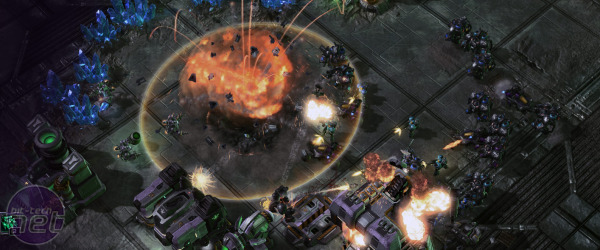
The truth of course is somewhere in between: RTS games never really stresses a graphics card in the same way FPS do, but StarCraft 2 is still a good looking game. It's not just the GPU that has work to do: with dozens of units on screen and the AI scheming away in the background, the CPU doesn't get off easy.
After our last article on
the number of cores games need, we decided to see how many CPU cores
StarCraft 2 requires.
The game engine uses DirectX 9.0c which does natively limit the multi-threading capacity of the graphics-software interface, however it also uses Havok physics which is all CPU driven. We used an
Intel Core i7-980X to maximise the core count available, but we disabled Hyper-threading and power saving states. A Hyper-threading core is not a 'real' core, it's just a piece of software trickery that opens up 'what's left' of the available CPU pipeline so could easily have created inconsistencies in our tests. We ran the game entirely run from the hard disk - no slower optical media was involved.
We cranked the game up to use its full detail setting and fired up a local game (required for consistent, reportable results) with seven other AIs to try and torture the system. We then built up an army and recorded a section with several dozen units on screen fighting each other.
Test Setup
- Intel Core i7-980X CPU, Hyper-Threading and power saving states disabled;
- Gigabyte GA-X58A-UD7 motherboard
- 6GB Crucial Ballistix 1,600MHz CL8 memory
- Asus ATI Radeon HD 5870 1GB graphics card
- Titan Fenrir CPU cooler
- Seagate Barracuda 7200.12 1TB SATA Hard Disk
- Seasonic X-Series 650W PSU
- Intel inf 9.1.1.1025
- ATI Catalyst 10.7 WHQL
- Microsoft Windows 7 Home Premium x64











Want to comment? Please log in.