Overclocking Intel's Core i3-530
Manufacturer: Intel
UK Price (as Reviewed): £95.80 (inc. VAT)
US Price (as Reviewed): $124.99 (ex. Tax)
In our original review of the
Core i3-530 CPU we loved the chip but found overclocking wasn't quite as fruitful as we'd liked. We thought the BIOS of our favourite Gigabyte GA-P55M-UD2 motherboard wasn't yet optimised for the new chip, so we made a note to come back to it a few weeks and updates later - and so we did, and it was still giving us the same result. Hmpf!
We tried another Gigabyte board: the P55M-UD4 - and there was still no joy as any attempt at serious overclocking rendered a failed POST. Unfortunately all our budget P55 boards have gone back to their respective manufacturers but instead we've been inundated with H55 boards. It's not all bad news for Gigabyte though, the H55M-UD2 works great with Core i3 so we've also featured this board and our OC settings over the next few pages.
We've included a basic setup guide for newer overclockers, and then a BIOS guide for several motherboards before benchmarks of how much extra performance overclocking can get your versus other popular CPUs. We rounded up a couple more H55 motherboards from Biostar and Gigabyte in order to test and show you the overclocking capacity with a Core i3-530.
The questions remain then: what potential does an Intel Core i3-530 buy you? Is it £100 worth of upgrade over that aging Q6600 or E-series Core 2 Duo CPU? What about compared to AMD's Athlon II or Phenom II series whose price-performance ratio is also quite impressive around this range?
Test Setup
Common Hardware
- ATI Radeon HD 5870 graphics card (Catalyst 9.11 WHQL)
- 1TB Seagate Barracude 7200.12 hard disk
- PC Power & Cooling 750W PSU
Intel LGA1366 (Core i7) Hardware
LGA1156 (Core i5, i3) Hardware
- Gigabyte GA-P55M-UD2 motherboard (stock) and Biostar TH55XE (overclocked)
- 4GB (2 x 2GB) 1,600MHz, CL9 DDR3
- Titan Fenrir TTC-NK85TZ
AMD Socket AM3 (Phenom II, Athlon II) Hardware
LGA775 (Core 2) Hardware
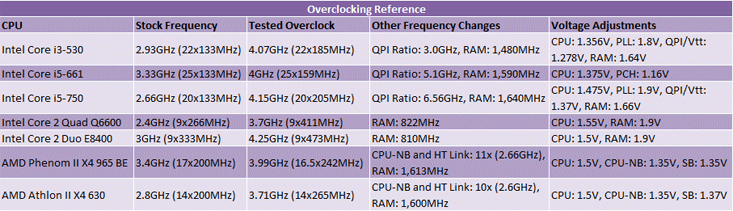
We also overclocked each CPU to its highest stable frequency – and collated all the figures in a handy Overclocking Reference table (see below).
 Click to enlarge










Want to comment? Please log in.