We have reviewed quite a few nForce 680i SLI boards, but many are built on the same core Nvidia design. Even though the boards are expensive, the nForce 680i SLI has become the de-facto product for those wanting SLI and an Intel Core 2 processor.
Even though there are boards from Abit, Asus, DFI and Foxconn that don't follow the Nvidia design, many of Nvidia's motherboard partners do and since this same BIOS applies to a vast majority of rebranded boards there should be a fair few people thinking of applying it.
There was a quite a bit of noise made about the P30 BIOS on the nForce 680i chipset, with specific optimisations made for general performance, memory and overclocking (including quad-core overclocking), we had to find out if this nine month old chipset has had a shot in the arm.
Specific improvements in the P30 are as follows:
- Improved overclocking for Kentsfield 1333 FSB CPUs
- Additional 1333 FSB Support for future CPUs
- Fixes intermittent S3 Resume bug
- Improve S3 resume functionality
- USB flash key functionality improvements
- Overclocking and memory improvements
- WHQL-related HPET fixes
- Quad-Core OC Improvements
- Additional support for 1333MHz CPUs
- Wireless PCI card fixes
- Vreg fan header default set to on
- Memory performance improvements
- Vista WHQL Certified
- USB Floppy improvements for RAID installs
- Correct CPU temp and voltage system monitor displays in BIOS
- Correct default CPU multiplier setting
- Fix "Code 50" hang received under certain VGA configurations
- Fix for SATA disk drives
- Improvements to memory stability and overclockability
- Disabled spread spectrum tables for improved overclockability
- Improve POST screen CPU speed reporting
- Improves X-Fi and internal audio functionality
- WHQL Certified BIOS
- Improvements to overclocking
- Enhancements for quad-core CPUs
- Adds ability to enable splash screen
So there’s not just
one improvement to overclocking, there’s apparently
four improvements. It doesn’t stop there because the P30 also features
two doses of memory improvements,
two 1333MHz FSB improvements and
two quad-core/Kentsfield overclocking improvements. Nvidia seems unable to do things singularly or even in odd numbers. Maybe the company works in pairs?
Sarcasm at Nvidia’s (and
EVGA’s) overzealous update list aside, there seems to be a lot more noise than the usual compatibility fixes and new CPU support updates. What is interesting, and slightly worrying is the specific fix for:
"Correct CPU temp and voltage system monitor displays in BIOS". So, is this implying that it's been wrong since release?
They look the same on the surface but by
how much can a BIOS improve a system performance and overclockability? In order to find out, we threw in a couple of CPUs into both an Inno3D nForce 680i with an original P23 BIOS, which includes the (now removed) LinkBoost feature, and a a couple of P30-based nForce 680i SLI boards from EVGA and XFX.
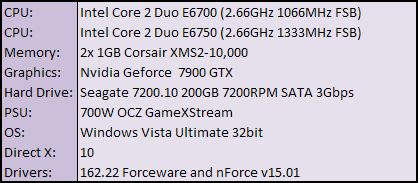
Test Setup
Motherboards:- EVGA nForce 680i SLI P30 BIOS;
- XFX nForce 680i SLI P30 BIOS;
- Inno3D nForce 680i SLI P23 BIOS;









Want to comment? Please log in.