Testing Time
We followed our standard case testing methodology, as detailed in our
previous heatsink and case testing article, and fitted the usual set of hardware into the Hiper Osiris, doing our best to hide and tidy cables to ensure as few airflow restrictions as possible. Here's a reminder of the hardware we use.
CPU: Lapped Intel Pentium XE 955 (dual-core, 3.46GHz)
Graphics Card: Sapphire Radeon HD 3850 Ultimate passive cooled
Motherboard: MSI P6N SLI Platinum
RAM: 2x 512MB Corsair XMS2-667
Hard Drive: 1x 250GB Western Digital WD2500 7,200RPM
Heatsink: Asus Silent Square Pro
Power Supply: Xilence XP700 700W PSU
While this isn't representative of current ultra high end hardware, the equipment we use is specifically selected to kick out the maximum of heat inside the case, with a passively cooled graphics card and 130W TDP processor at its core to really heat things up and push the case's ability to cope with toasty components to the limit. If the Hiper Osiris can cope with this setup, it should comfortably handle anything.
With a near identical cooling setup to the current performance leader, the Zalman GS1000, we were expecting the Hiper Osiris to deliver some impressive operating temperatures, and even potentially claim the top spot for CPU load, with those two 120mm cooling fans placed so closely to the heatsink.
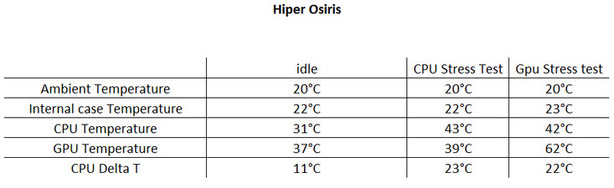
-
Akasa Omega - all fans
-
Zalman GS1000
-
Akasa Omega - stock fans
-
Hiper Osiris
-
Lian Li Tyr PC-X2000 - high fan
-
Lancool K7 Metal Boned
-
Akasa Mirage-62
°C
-
Ambient
-
Case
-
CPU
-
GPU
-
Load Delta T (CPU)
-
Hiper Osiris
-
Zalman GS1000
-
Lian Li Tyr PC-X2000 - high fan
-
Akasa Omega - all fans
-
Akasa Omega - stock fans
-
Akasa Mirage-62
-
Lancool K7 Metal Boned
°C
-
Idle
-
Case
-
CPU
-
GPU
-
CPU Delta T (load)
-
Akasa Omega - All Fans
-
Lian Li Tyr PC-X2000 - high fan
-
Zalman GS1000
-
Hiper Osiris
-
Akasa Omega - stock fans
-
Lancool K7 Metal Boned
-
Akasa Mirage-62
°C
-
Ambient
-
Case
-
CPU
-
GPU
-
GPU Delta T











Want to comment? Please log in.